

Managing Apache Spark#
Introduction#
Querona ships with a single, pre-configured instance of Apache Spark that starts automatically. Spark is a separate entitity from Querona and works independently in a dedicated Java process. However, Querona manages Spark configuration and lifecycle, and uses it for the following purposes:
a default federation engine,
a ready-made materialization target for end users, available for use via a pre-configured connection.
The Querona Spark driver#
Querona communicates with Spark through the Querona Spark driver, a gateway that carries requests and results in both directions between Querona and Spark. On a Spark cluster the driver runs on the cluster head nodes; it is resilient and follows the active head node when a new head-node election takes place.
When Spark calls back into Querona over a reverse connection — for example, while executing a distributed task — Querona spools the query results. This lets a Spark task be retried and obtain the same, stable result again.
Instance management#
Local Spark instance management options can be found under the .
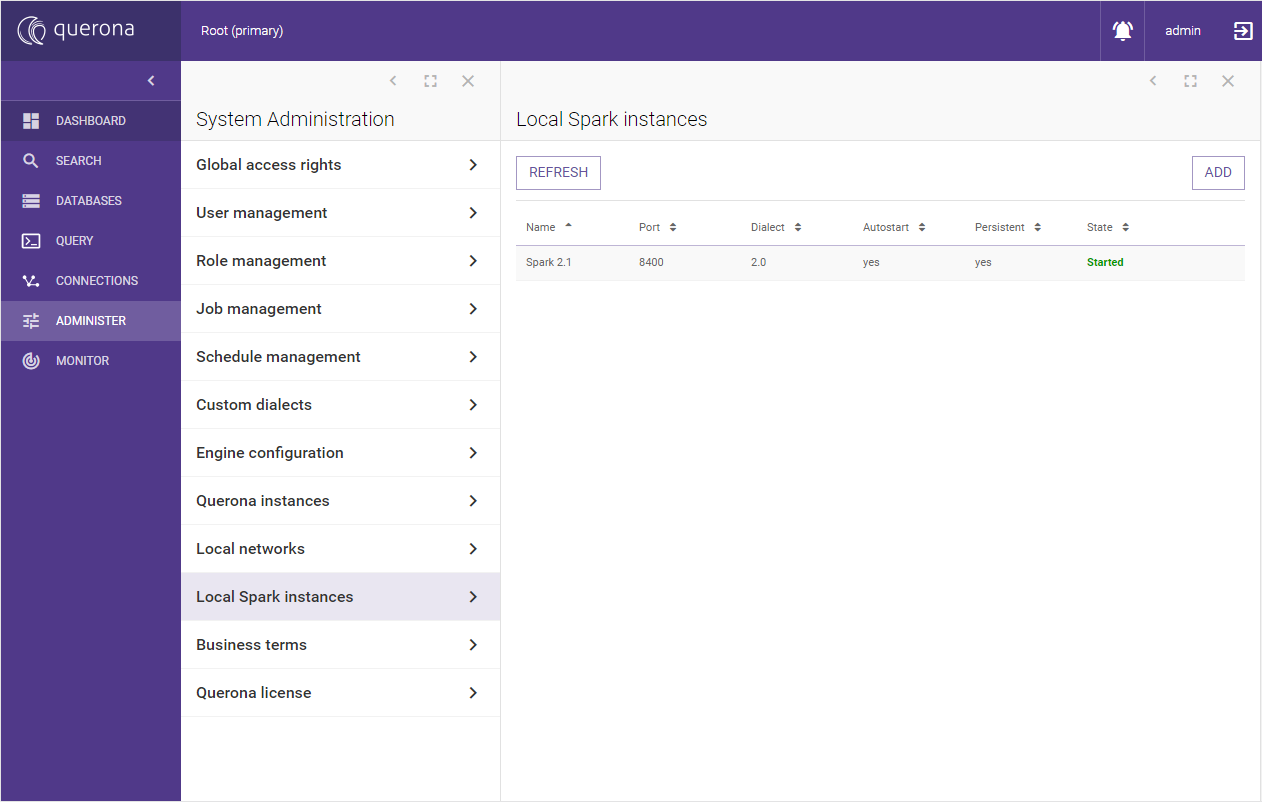
Viewing instance status#
Selecting the instance brings up the details blade with all configuration values in read-only mode.
Click the Refresh button to refresh the instance list and to ensure the State column shows the latest information. The view has not auto-refreshing functionality so it might be necessary to use it a few times during state transition.
Starting and stopping Spark instance#
The following buttons control the instance state:
Button |
Action |
|---|---|
Start |
Starts the instance, if not already started. |
Stop |
Stops the instance, if not already stopped, by sending a “self-shutdown” command, allowing the instance to free all resources and close itself gracefully. This may take up from one minute to several minutes, depending on the load and instance size. |
Kill |
Kills the instance without waiting for a clean shutdown, by sending an OS-level kill signal which terminates the underlying JVM process (not recommended, unless a graceful shutdown fails). |